Bird Droppings November 18, 2026
I Was Thinking Castle
What can you build with six Duplo blocks and a wooden block?
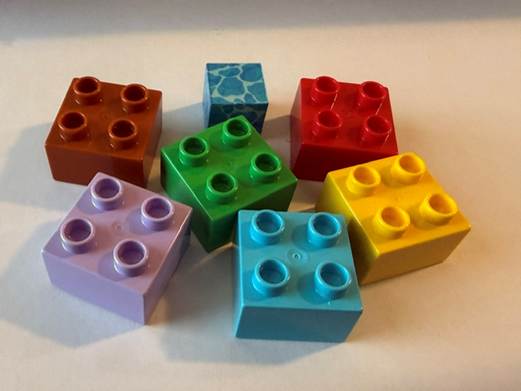
That question followed me home this morning. Of course, it took a little wandering to get there.
Five deer, five crows, one goose, and one squirrel appeared. A thin orange ribbon stretched across the horizon, thirty-three degrees outside, and the heater warmed my back. The lake was quiet. Yesterday’s brilliant sunrise had brought me back out, but this morning offered smaller things to notice. Somewhere along the dirt road, I got to thinking about how long we human beings have been trying to tame nature. Then I wondered how long we adults have been trying to make children a little more like us. It’s funny how seldom we turn that around. I’m seventy-seven years old. How good am I at thinking like my grandson Henry, who’s six?
After years of chasing sunrises, I have learned to keep the camera ready. Charge the battery. Make sure the chip is in. Pay attention. You never quite know what the next bend in the road might offer. Teaching calls for that same readiness. Every so often, a student comes alive with questions, ideas, and connections. One teachable moment follows another, and suddenly we are learning together. Then come quieter days. I may wonder where that excitement went, even as something takes shape that I cannot yet see. I need to keep showing up with the same curiosity that takes me down the dirt road each morning.
As I drove, I caught myself saying, “We’re limited to what Henry knows.” Now Henry knows quite a bit for a six-year-old. And the longer I thought about it, the more I wondered which one of us I was talking about. How much of what Henry knows have I taken the time to learn? Somehow that brought me to Duplo blocks. Picture a child walking into your classroom with six blocks in their pocket. Along comes another with fifty. That child has blocks in their backpack, blocks in their jacket, probably a few more than they remember putting there.
Those blocks are the experiences each child can draw on for whatever we’re about to do together. Family stories, languages, culture, games, interests, and things learned while helping somebody at home. In my coursework, we call these funds of knowledge. Tomorrow, doing something different, I might be surprised at whose pockets are full.
But how would I know how many blocks a child had in the first place? Perhaps I counted only the ones I recognized.
Now, what if I don’t care for Duplo blocks? I’ve come in with a lesson planned, I know how I want it done, and those blocks can stay right where they are. Six or fifty, it amounts to the same thing. I’ve decided what counts before either child has emptied a pocket. Of course, I happen to like those blocks. Give me six, and I can make something. Give me fifty, and I can build a castle. But there I go again. Both times, I’m the one doing the building.
Then another thought interrupted my wandering. Who said they were all Duplo blocks?
What if a child brings a wooden block? What if there are pieces from several different building sets? Some connect easily. Others leave me scratching my head. A child might know exactly what to do with a piece I have overlooked. Before I start explaining how everything fits, perhaps I ought to ask him to show me. I think about sitting with Henry playing Mancala. He put eighteen and seven together and got twenty-five. If I want to teach him something from there, I’d like to know how he got there in the first place. “How’d you figure that out, Henry?” is a question I can ask and mean. He was the one counting. I’m curious what he saw.
And then there is imagination.
Don’t you build castles with Duplo blocks? Castles and forts. That was where my mind went. Give me six blocks, and I begin figuring out how high the walls can be. Give me fifty, and I can make something considerably bigger. I could already picture walls and a gate before we had put the first two pieces together. Henry could imagine something entirely different with those same pieces. I was drawing on years of experience, following a familiar path. He wanted to go somewhere else.
Experience gives me plenty to offer him. It also gives me familiar ways of doing things that I can settle into without ever asking what he has in mind. I can get so busy helping that I take over the building. How often do we adults ask children to think like us? How often do we explain what is practical or possible before we have heard what they are imagining? I wonder what ideas we might hear if we gave them a little more time.
That is the hard part for me. I like to help. I can see a place where the next block could go, and my hand is already moving. Staying curious means pausing long enough to find out where the child wants to put it. I wonder how often we decide what children should produce before we discover what they are thinking. And I wonder how that carries into the way we organize schools.
I would like to begin with students, teachers, and parents learning about one another. What do they bring? What do they hope for? What helps them learn together? From those relationships, we could think more about the classrooms, the buildings, and the leadership needed to support their work.
How can we guide learning well unless we spend time where it happens?
By the time I headed home, I had schoolwork waiting, kitchen cabinets to clean, and supper to figure out. Somehow, a quiet morning drive had given me another question to carry upstairs. Maybe tomorrow a child comes in with six Duplo blocks, sets five on the table, and keeps one in his hand. I could reach over and show him where that last one fits. Would it be better to pause before reaching for that block and ask, “What do you have in mind?”
Henry wanted me to build a car.
I was thinking castle.
Please keep all in harm’s way in your minds and in your hearts, and please always give thanks, namaste.
My family and friends, I do not say this lightly,
Mitakuye Oyasin
(We are all related)
docbird


Leave a Reply