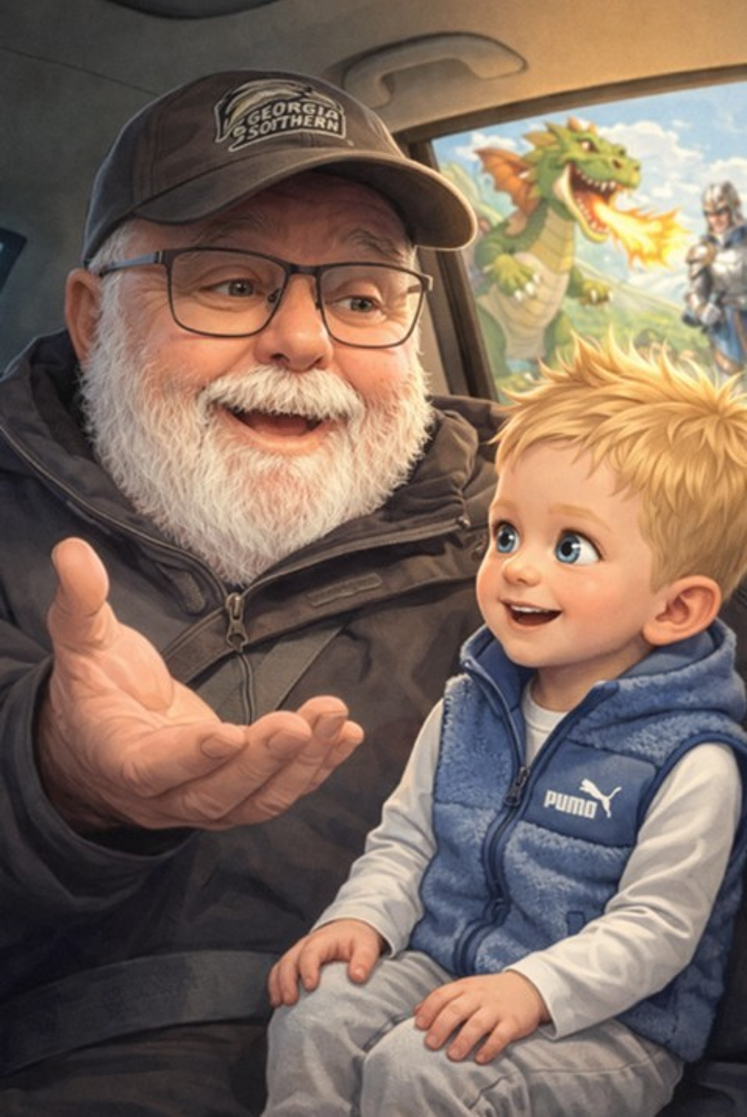
The Osmotic Teacher
Stories, Relationships, and the Art of Learning Together
Chapter One
Sometimes the Student Is the Teacher
After more than fifty years of working with children, I found myself sitting beside a six-year-old boy who was teaching me about dinosaurs. I had started out thinking I was going to teach him something about reading. Sometimes things just don’t work out the way you plan.
The six-year-old was my grandson, Henry. He’s in first grade, loves mathematics, enjoys building things with Legos, and has a pretty good idea about how the world ought to work. He’s also quick to correct his grandfather when I make a mistake. I suppose after all these years of teaching, I should be accustomed to being corrected by a first grader.
Henry and I were working on a reading project for one of my graduate classes. Yes, graduate classes. At seventy-seven, I’m still going to school. I have a doctorate in education, a master’s degree, a specialist degree, and a bachelor’s degree from the distant past. Yet here I am, working on another degree, this time in elementary education. Some people might question my sanity.
I have wondered about it myself on occasion. But I have always enjoyed learning, and I have always enjoyed working with children. I don’t know that I ever really retired from teaching. I just keep finding different ways to do it.
That morning, I had gathered a stack of books for Henry. There were probably ten or fifteen of them, ranging from simple picture books to books that would challenge a beginning reader. I wanted to see what interested him and get some idea of where he was in his reading development. I had my assessment materials ready. Word lists, reading passages, an interest inventory, and the usual assortment of things educators use to determine what a child knows and what he needs to learn. I told Henry to look through the books and pick one.
He chose a book about a Tyrannosaurus rex. Not just any dinosaur book. This was a cross-section book showing the skeleton, muscles, and internal organs of a T. rex. It was probably the most difficult book in the entire stack. I wasn’t surprised.
Henry had looked through that book many times before. He knew what was in it, and he was ready to explain it to me. Before long, he was pointing out bones, muscles, and organs, telling me how the dinosaur was put together. I listened, asked questions, and let him show me what he knew. Somewhere along the way, I realized that the lesson had changed. I was supposed to be assessing Henry’s reading. Instead, Henry was teaching Pop Pop about dinosaurs. And I was enjoying every minute of it. I wonder how often that happens in classrooms without anyone noticing. A teacher prepares a lesson, gathers materials, sets objectives, and begins the day knowing exactly what students are supposed to learn. Then a child asks a question. Or brings something to school. Or makes an observation that has absolutely nothing to do with the lesson plan. And suddenly there is an opportunity.
The question is whether the teacher recognizes it. I have spent much of my life thinking about those opportunities. Sometimes I recognized them. Sometimes I probably missed them entirely. I suspect that many of the most important things I learned about teaching came from moments when a student did something I hadn’t anticipated. Henry and his dinosaur were simply the latest reminder.
What the Word Lists Didn’t Tell Me
Earlier, Henry and I had started with a little book we made together called Pop Pop and Henry Tell Stories. Henry helped choose the pictures. One showed him playing with blocks, another showed him fighting dragons, one showed us telling stories while he sat in my lap, and one showed Sunny, our leopard gecko. I had included his kindergarten sight words throughout the book, printing them in red so they would stand out. Henry read every red word correctly.
Some of the other words gave him trouble.
That was important information. I needed to know which words he recognized, which ones he could sound out, and which ones were still unfamiliar. We moved on to a word list, and he did quite well at first. He recognized the words in the first column and several in the second. Eventually, he began sounding out words such as work, best, play, just, some, and they.
When he reached people, he stopped. I decided that was far enough for the moment.
There is a difference between discovering what a child knows and pushing until the child feels defeated. Assessments have their place, and good assessments provide information that teachers need. But the child sitting across from us is more important than finishing a list of words.
We also read a little story called I Like Birds. I rather liked the title. Two Birds sitting together reading about birds seemed appropriate. Henry stumbled over some of the words, repeated others, and corrected himself along the way. But when I asked him questions about the story, he answered all five correctly. He understood what was happening. That gave me something to think about.
His word recognition and oral reading needed work, but his understanding of the story was stronger than his reading performance might have suggested. I could have looked at the errors and decided that Henry was simply struggling with reading. Or I could look a little more closely and begin asking why. What was he doing when he encountered an unfamiliar word? Was he using the illustrations? Was he remembering the story? Was he trying to sound out the word? Was he making sense of what he read? Those questions interested me far more than simply counting the words he missed.
I have known children who could read words beautifully without having the slightest idea what they had just read. I have also known children who struggled to decode words but could explain complicated ideas when someone took the time to listen. Reading is not a single skill. Neither is learning. And neither can be fully understood by looking at one number on a score sheet.
The Dinosaur and the Interest Inventory
Later, I asked Henry some questions about his interests. He likes basketball, soccer, hockey, and fishing. He enjoys riding his bicycle, swimming, playing video games, and spending time with dogs. He had recently attended a hockey game in Athens and was excited about that.
When we got to questions about books, he indicated that he liked action stories. That made sense. Henry likes dragons, adventures, and just about anything that involves a little excitement.
But he showed less interest in informational books and animal books. I looked at his answers and thought about the dinosaur book.
Here was a child who had just spent a considerable amount of time showing me the internal organs of a Tyrannosaurus rex, yet he wasn’t particularly interested in animal books. At least that was what the inventory suggested. He also showed little interest in made-up stories, even though he and I have been making up stories together for years. Now, I don’t think Henry was trying to fool me. I think he answered the questions as he understood them in that moment. Perhaps he didn’t think of dinosaurs as animals. Perhaps he didn’t think of our storytelling as the same thing as reading made-up stories. Perhaps the categories simply didn’t mean to him what they meant to the person who wrote the inventory. Or perhaps he just felt differently that morning. Children are like that. Adults are too, for that matter.
But it reminded me of something that has long bothered me about education. We ask children questions, put their answers into categories, and sometimes assume that we understand them.
We have reading levels, grade levels, achievement levels, behavioral classifications, and enough educational terminology to fill a good-sized dictionary. Those things can be useful. Some are essential for making instructional decisions and providing appropriate support. But none of them tells the whole story. The little boy who checked a box indicating little interest in informational books was the same little boy who couldn’t wait to show me a dinosaur. If I had only looked at the inventory, I might have missed that. And if I had only looked at the word list, I might have missed much more.
I began wondering how often teachers overlook a child’s strengths because those strengths don’t happen to appear on the assessment being administered. How often do we miss curiosity because we’re measuring accuracy? How often do we overlook enthusiasm because we’re concentrating on performance? And how often do we forget that children come into our classrooms already knowing things worth knowing?
Ten Out of Ten, Pop Pop
One question in Henry’s interest inventory asked him to name five favorite people.
He started with Mommy and Daddy. Then Grandmommy. Then Chloe. Chloe, incidentally, is his Chihuahua. I suppose when you’re six years old, dogs deserve a place on a list of important people. His fifth choice was his great-granddad, someone he knows through pictures and the stories I’ve told him. I looked at Henry. “Well, Henry, what happened to me? Where’s Pop Pop on your list?” He didn’t hesitate. He gave me a thumbs-up and a fist bump. “Pop Pop, you’re ten out of ten.” I told him I could live with that. I have thought about that little exchange several times since.
I was trying to find out what interested Henry, what he knew, and how I might help him become a better reader. Henry was reminding me of something I had spent a lifetime learning.
Relationships matter. They matter when children are six years old, and they matter when children are sixteen. They matter when a student is excited about learning, and they may matter even more when a student has decided that school has nothing worthwhile to offer. I spent many years working with children who had emotional and behavioral difficulties. Some had experienced more rejection and failure than most adults could imagine. Some were angry. Some were frightened. Some had learned to protect themselves by refusing to participate. Some students came into my classroom convinced that teachers didn’t like them.
Occasionally, they had good reasons for believing that. I learned that before I could teach some of those children much of anything, I needed to establish a relationship. They needed to know that I would listen. That I would try to understand. That I wouldn’t disappear the first time they made a mistake. And that they were worth my time. It wasn’t always easy. Some days, I wondered whether I was accomplishing anything at all. But every so often, something happened that reminded me why I had chosen to teach. Sometimes it was a conversation. Sometimes it was a smile. Sometimes it was a student who finally trusted me enough to ask for help. And sometimes it was something as simple as a six-year-old giving his grandfather a ten-out-of-ten rating.
I wonder how many children go through an entire school day without feeling that they are a ten out of ten to somebody. Not because they earned a perfect score. Not because they behaved perfectly. Not because they completed every assignment. But because somebody saw something worthwhile in them. I don’t believe that relationships replace instruction. Children need to learn to read, write, solve problems, and develop the skills that will help them throughout their lives.
But I do believe relationships create the conditions for meaningful learning.
And that brings me back to a thought that has followed me through much of my teaching career.
Perhaps teaching isn’t simply moving information from one person who knows to another person who doesn’t. Perhaps there is something more to it. Perhaps learning moves in both directions.
I have come to call that idea the osmotic teacher. But before I explain what I mean, I need to tell you about some of the children who taught me how to teach.


Leave a Reply